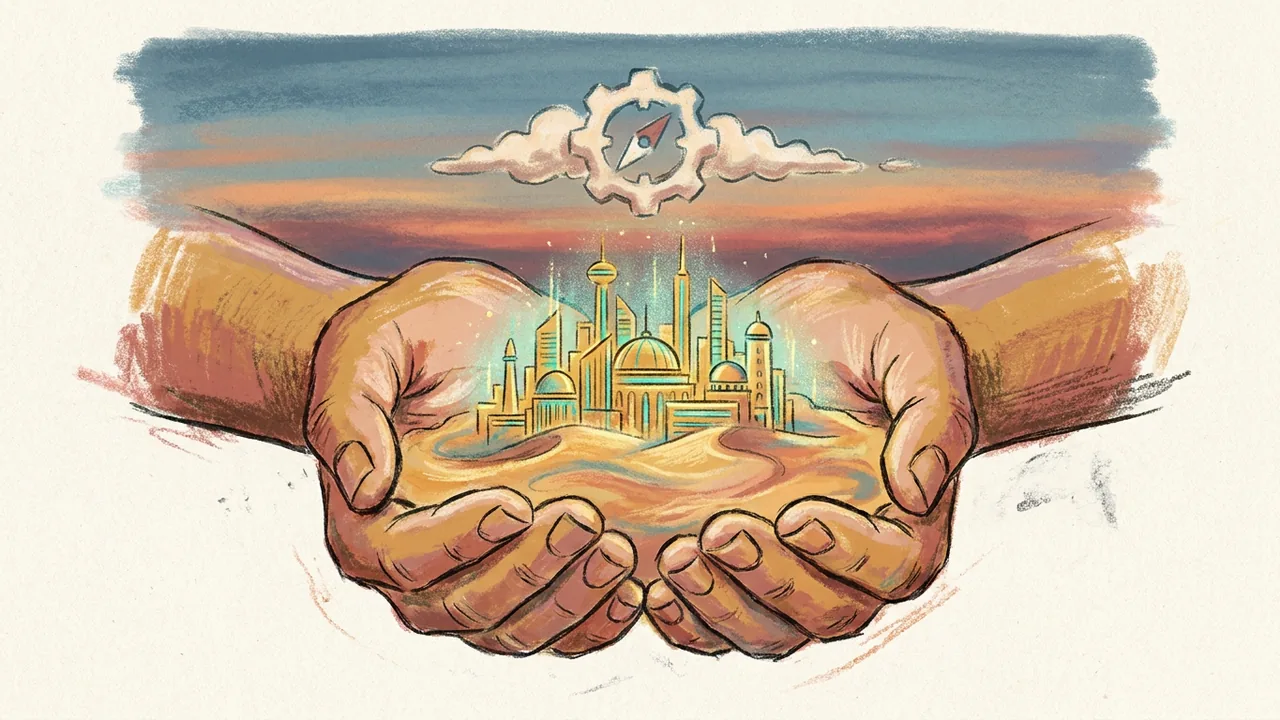
What building spatial tech in Dubai taught me
Our platform is registered in the US, yet we moved to Dubai. People assume the answer is sunshine and zero tax. Those help — but the real reason is something founders rarely get from a government: a strategy stated in concrete steps.
I watched a member of the ruling family stand on a stage at the Museum of the Future and lay out the plan — not in slogans, but in numbers: this many jobs, these subsidies, these milestones, in this order. As a founder, that’s gold. I walked out knowing exactly which stages exist and how to move through them here. Most places make you guess. Dubai hands you the map.
Why the model works for builders
Stack a few things together and the appeal becomes obvious:
- Clarity. A long-term plan, published and then actually executed — which builds trust. Once a place delivers on one big long-term promise, you start believing the next one.
- Concrete on-ramps. Zero tax, plus a genuine openness to operating internationally and with digital assets — including preparing the legislation for them.
- Institutions that move. When a new technology appears, they spin up a ministry for it. There’s a ministry for AI; there are people drafting how we’ll legally treat a digital object — if I own a digital version of this glass of water, how do I prove ownership? Those questions are being written into law, not ignored.
The “subscription city”
Dubai is unusually compact — a few million people, of whom only around 10% are local; the rest come from everywhere. That mix is the point. It feels like a Babylon of overlapping interests, a place of citizens-of-the-world. And you can join almost like a subscription: arrive, and quickly get residency, insurance, a licence — the way you’d order a taxi, you become part of the community. For a global, mobile team, that’s a profound unlock.
There’s a quieter benefit too: safety. When you’re not subconsciously guarding your things, you can actually focus on the work. I’ve left a laptop in a café and come back to find it untouched; a friend dropped an expensive ring in the street and a stranger handed it in. Small things — but they free up the attention a startup needs.
How credibility actually works
Here’s the part the brochures skip: it is centralized. Nearly every major developer, bank, or authority connects, one way or another, to the ruling family — it’s effectively one interconnected structure. Which is exactly why credibility comes first. You don’t walk in and pitch. You earn standing.
In practice that meant starting with the kind of project that opens doors — for us, an augmented-reality piece built around the ruler’s poetry, presented with the right introductions. Only after you’ve established that you’re credible does the real conversation begin. And it takes time: ours was roughly two years of drinking coffee, knocking on doors, and showing up before the doors genuinely opened. Anyone who tells you they landed and built overnight is selling something.
The digital twin — and its weak point
The most interesting work has been around Dubai’s digital twin: a 3D copy of the city so detailed it runs to enormous size. There are two layers to it. An internal layer helps developers and authorities get to information and make decisions faster. An external layer — the one I care most about — is for ordinary people: navigation, everyday tasks, a more usable city.
The twin’s weak point is freshness. Dubai builds so fast that a copy made once a year is already wrong — and it’s wrong exactly where it matters most, at the ground floor, the part residents actually live with. The answer is to let citizens help keep it current through their own devices, with a light layer of gamification so contributing is something people want to do. That’s the same idea I explore in AR crowdsourcing: residents as a living sensor network for their own city.
Will the state keep leading?
For now, yes — and strongly. Government will keep the central role here for a long time; the structure is built that way. What I find healthy is the rhythm: they grant builders room to experiment, watch what works, then shape and formalize it. Combine that with genuine long-term planning, and you get something rare — a place stable enough that a young company is willing to move its whole life there. Call it a digital home for a digital nomad. That stability, more than the weather, is why we stayed.
Thinking about where — and how — to build a spatial product?
I’ve done it across markets and with government-scale partners. Book a 1:1 call.
Book a call →