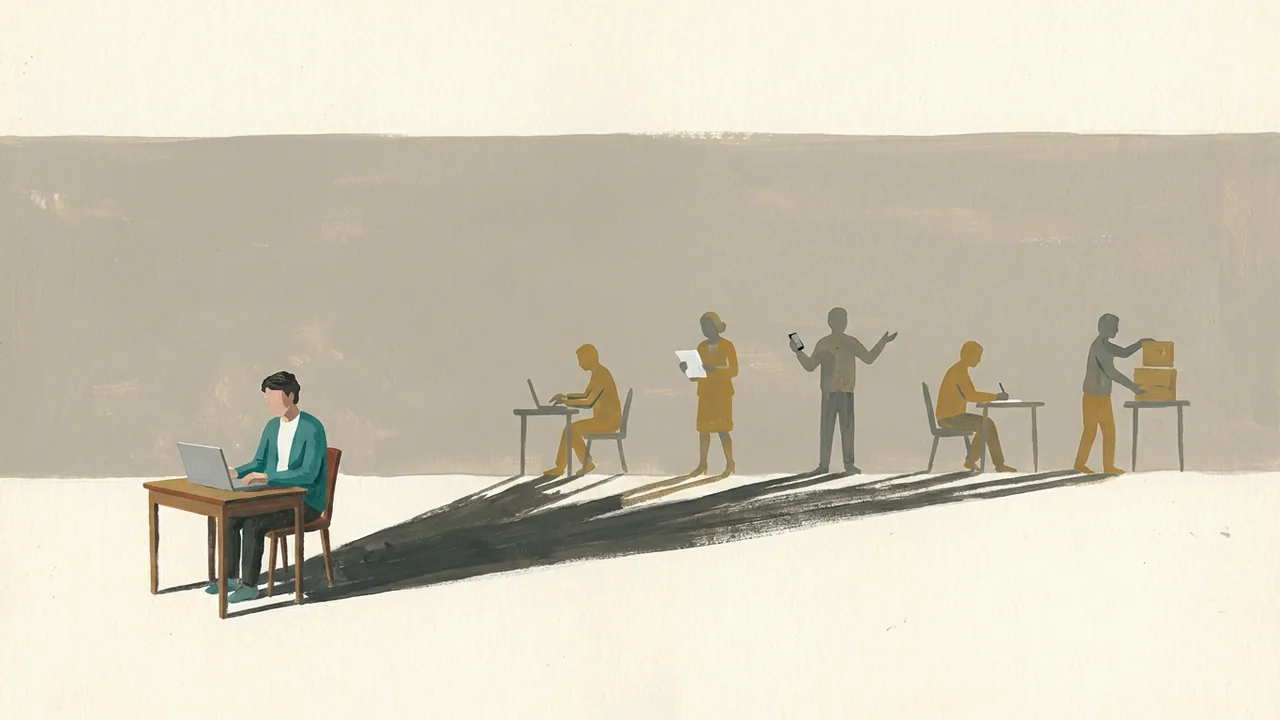
A country of geniuses
The world is moving away from one shared digital space. Technology stacks are becoming a battleground over who gets to describe reality, and companies are learning to live in a new logic. Today one person, amplified by AI, can launch products, test ideas, and run processes that used to need big teams.
There is a clear trend in the world, from globalism toward closed structures inside nations. The internet, the previous big planetary structure, was meant to live beyond borders. Yet we see closed, self-contained loops appearing, and not only in China. For me the most important story in the AI world is the global competition between the American technology stack and the Chinese one. Whoever controls the stack controls what counts as truth inside it. The fight between these stacks will shape society and business deeply.
For countries to keep their own view of the world, and for a "neutral product" to exist, we need decentralisation. Nations without the huge compute of China or the US can pool their smaller GPU resources to have an alternative. If your business has things that follow patterns, AI will change it a lot. In programming, for example, what used to be the privilege of a certain group can now be done by AI agents. The lead role goes to the orchestrator, a kind of architect who controls how code gets made. Which means the business of outsourcing programming has already gone through a huge transformation. But I disagree with the "AI boyars"* who think AI has already taken over the world.
Vibe coding lowered the barrier to entry in some fields. The company of the future might be a single, radically amplified specialist who knows how to direct a set of AI agents. You can see it even in our own company: we have half a million users, and there are three of us building it. This is amplification by tens of times, not just a few. It is like a new league of chess, where it is not human against human, but human plus AI against another human plus AI.
We have half a million users, and there are three of us building the company. This is amplification by tens of times, not just a few. It is like a new league of chess: human plus AI against another human plus AI.
In business, the speed of testing ideas and the path from idea to shelf have grown enormously. With AI I can test how new product pages will perform, automate it, and turn it into a pipeline. In practice this means one thing: more people will be able to launch a product without a team. Other things gain value instead. Reputation. The way you deliver. Creative ways of talking to your audience.
Agencies will sell taste, and the skill of delivering content and creative. A tool that used to need a team of 3D designers can now be augmented by AI. Big global agencies' videos cost tens of thousands of dollars. On oMagic a video costs one dollar. Even a small pharmacy in Nepal can afford it. The viewer will not always tell whether it is AI or not. If you felt something, got the "wow", got curious about the brand, that is what matters most. (More on this in AI is collapsing the cost of content.)
The value of human craft will not go anywhere. Apple recently released an ad for the MacBook Neo where all the effects and graphics were made with physical objects. Many brands have started showing how they make things by hand. AI and human work will balance each other. Renting small AI agents for work will become normal. You will be able to buy AI agents from different companies and consult them, understanding that behind them sits a lot of human work and, most of all, a large body of structured data. I can already imagine that in 2030 we will do a normal interview, and at the same time, during our physical conversation, my AI agent will be talking to yours at hundreds of thousands of tokens per second. The conversation between people can stay the core; to check the facts, you can always turn to the agents.
The future is a country of geniuses in a data center. Imagine a whole country made of geniuses and Nobel laureates, all of them at your disposal. A colossal resource appears, in the form of agents.
At the head of the company of the future is a conductor with a tuned set of instruments. I can't remember the last time I didn't start an AI job for the night. While I sleep, AI gathers data and research, or does routine social work, and I keep the right of final approval. This is the same idea I keep coming back to: AI plus human judgement, with the human still deciding. The people who work on AI in big corporations are driven by a positive future. Even though corporate capitalism puts profit first, the AI visionaries have good intentions. I believe this. I see how much gets better with AI, and I am impressed.
It is more interesting to take part in shaping the future than to stand aside. A window of opportunity is open now. You can contribute to the industry. Startups can stay flexible and find that boost, and a new idea.
* "AI boyars" is a term for the AI giants as the new feudal lords who make our digital products.
First published in Founders magazine, June 2026. Text: Ivan Puzyrev. Interview by Nadezhda Rumak.
Building a product with a small team and AI?
That is exactly the shift I help founders navigate. Book a 1:1 call.
Book a call →