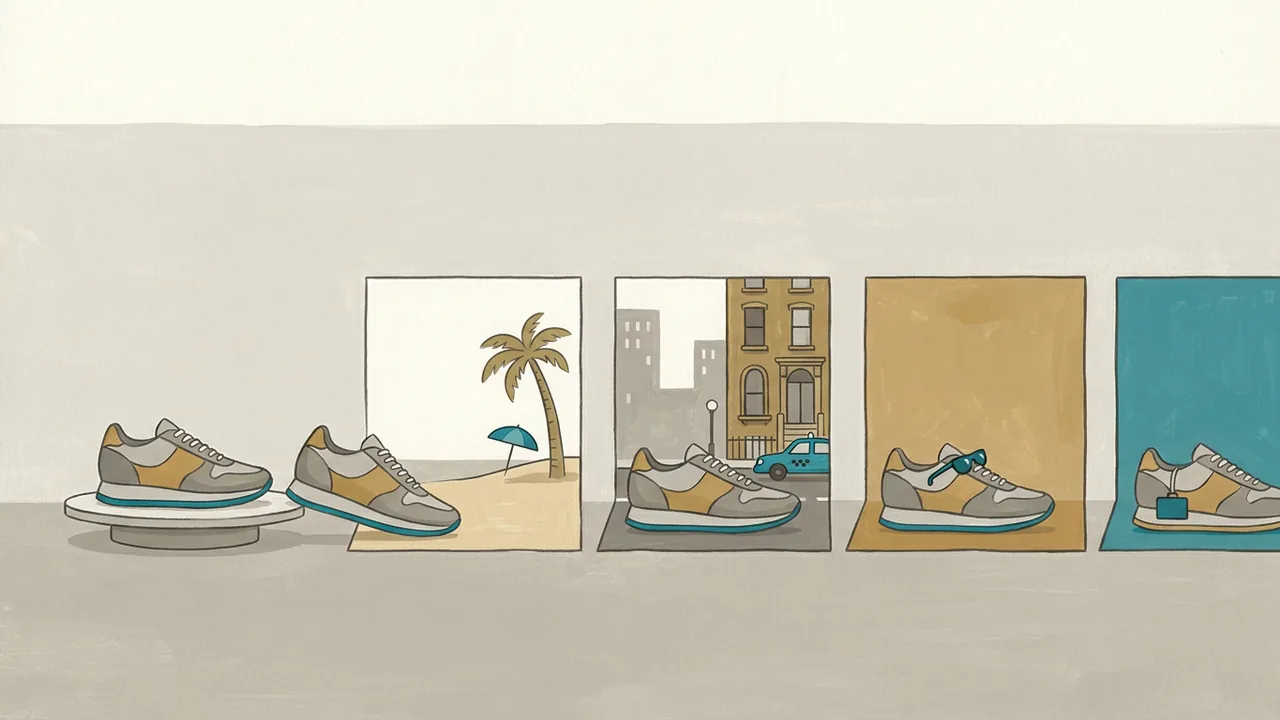
Hybrid product visualization: capture once, render everywhere
For years, making product images meant a new photo shoot for every product, every channel, every campaign. AI changed the cost of pictures, but most teams still treat it as a pile of one-off graphics tools. In a new paper I argue for a different unit: not the image, but the reusable product asset and the workflow around it.
- Capture a product once as a geometry-accurate 3D asset, then let AI render every scene around it.
- The product stays exact — shape, branding, regulated copy — while only the surrounding scene changes.
- It is an operations capability, not a graphics trick: one reusable asset, controllable and personalisable at scale.
The problem with treating AI images as tools
Online, a store competes on how fast and how consistently it can produce product media across its website, marketplaces, paid ads and social. Today most teams reach for a generative tool, type a prompt and hope. You get a nice picture, but the product drifts. The shape is a little off, the colour is not exactly the colour, and there is no clean way to reproduce or govern it at scale. I wrote about that gap between a good demo and shippable work in guided AI beats the magic button.
What hybrid product visualization is
The idea is simple to say and useful to build. First you capture the real product once, as a geometrically faithful 3D asset reconstructed from photos of the actual item. Then you let generative models build scenes, backgrounds and campaign variations around that asset. It is hybrid in a precise sense: a deterministic, product-true asset on one side, probabilistic generative rendering on the other. Not flat 2D photography. Not fully generative imagery that quietly reinvents the product. The real object stays fixed, and only the world around it changes.
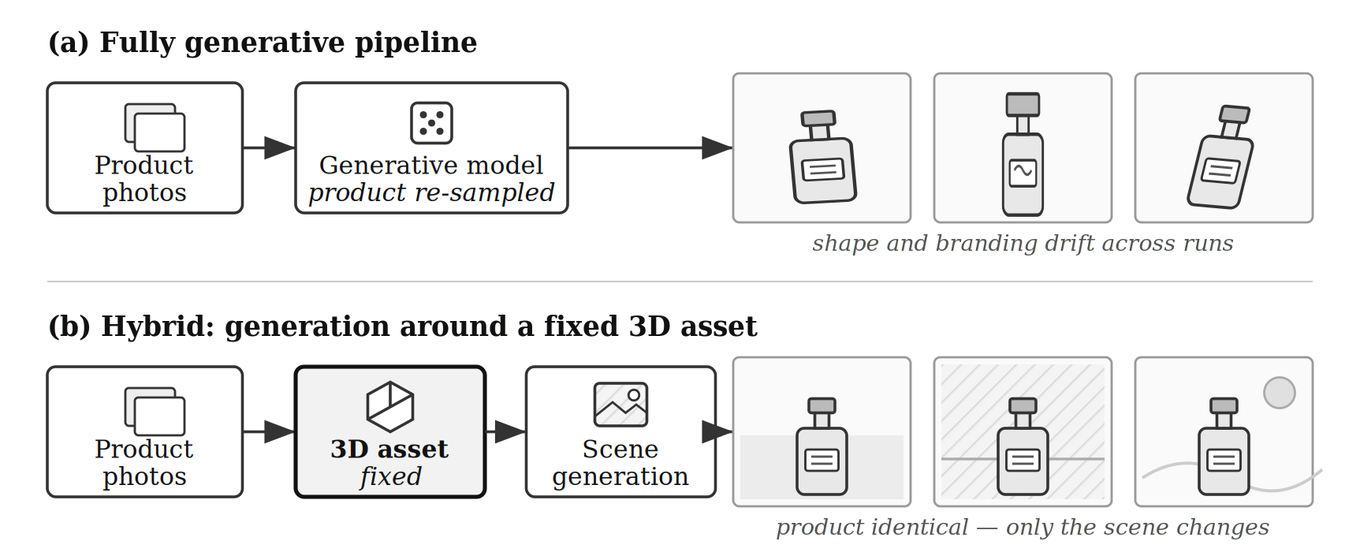
The unit is not the image. It is the reusable product asset and the production workflow built around it.
Why this is an operations capability, not a graphics trick
Once you have that reusable asset, product media stops being a series of one-off outputs and becomes a production architecture. The same 3D capture is the control point for everything downstream: a summer campaign, a marketplace thumbnail, a personalized banner for one shopper, a localized variant for one market. It is scalable, because you reuse one asset. It is personalized, because you can re-render it per context. And it is governable, because there is a single source of truth for what the product actually looks like, which matters when you answer to brand teams and regulators. That is the shift from a tool to an information systems capability. It also connects to a pattern I keep coming back to, that AI collapses the cost of good content and moves the real constraint from budget to imagination.
Why I wrote it as research
I run this at Magic every day, but I wanted to give it a proper frame. Together with Andrey Berezin and Kwabena Frimpong at KFUPM, we wrote it up as a paper, From Product Capture to AI-Enabled Retail Media Operations, accepted at SaudiCIS 2026, the 2nd Saudi Conference on Information Systems, and it will appear in the AIS Electronic Library. The academic contribution is an asset-based production architecture seen through a dynamic capabilities lens. The practical one is simpler: capture the product once, render it everywhere, and manage the asset, not the picture.
Building product media at scale?
I help teams turn one-off AI graphics into a real production capability. Book a call.
Book a call →